Bangkok Apartment Buying Guide: Prices, Transit, and Rental Demand
In Bangkok, an apartment’s price depends less on the district itself than on the distance to the nearest BTS or MRT station, a 25–30% difference between neighbouring buildings is not uncommon if one is within walking distance of the metro and the other is a kilometre away. Below are actual figures by district, how metro expansion will affect prices by 2027–2030, which areas to avoid due to flooding, and what to check about the building’s legal entity before signing.
Key takeaways
- The real premium for proximity to BTS/MRT, and why it affects not just convenience, but also price and returns
- Prices and rental rates by area, Thonglor, Ekkamai, Silom/Sathorn, Ari
- What to check before buying, flood-prone zones, the building’s legal entity, and the reserve fund’s status
Transport determines the price before the neighborhood does
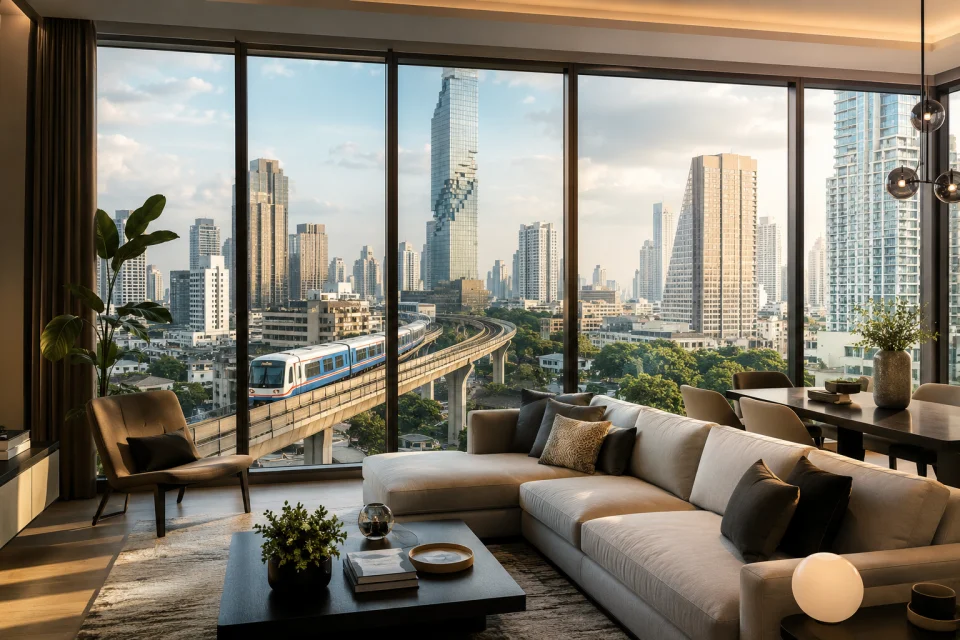
According to CBRE Thailand, apartments within 400 meters of a BTS or MRT station cost 25-30% more than comparable properties one kilometer from the metro. The difference is also noticeable in how quickly they are rented out: an apartment within 500 meters of a station rents out 30-40% faster than a comparable property farther away.
For a rental or resale investment, aim for a property within a 300-500-meter walk of a station. Within this radius, journey times remain consistent regardless of Bangkok traffic, and tenants and future buyers are willing to pay a premium for that predictability. The citywide average price at the beginning of 2026 was around 150 000-155 000 THB per m², but in prestigious neighborhoods near the metro, prices reach 150 000-250 000 THB per m² and higher.
Apartment prices by neighborhood
Thonglor remains at the premium end of the market at 150 000-350 000+ THB/m². Ekkamai offers a similar location and lifestyle for 15-25% less, 120 000-220 000 THB/m², making it an accessible entry point for buyers who value the neighborhood but are not prepared to pay Thonglor prices. Silom and Sathorn maintain steady corporate demand and are positioned as more affordable alternatives to premium Sukhumvit. At the beginning of 2026, Ari ranked among the three most popular neighborhoods for foreign buyers, combining international restaurants, embassies, multinational company offices, international schools, and hospitals such as Bumrungrad, all within walking distance of the BTS.
Rent: rates and demand by neighborhood
In Thonglor, one-bedroom apartments rent for 22 000-32 000 THB/month, while rates in premium buildings regularly exceed 100 000 THB. In Silom, a decent one-bedroom starts at 25 000-35 000 THB/month; a new-build apartment with a gym and a view costs 40 000-55 000 THB, while two-bedroom units are 50 000-70 000 THB. In the Phrom Phong area of Sukhumvit, premium properties start at 35 000 THB and exceed 60 000 THB for top-tier units. Ari is considerably more affordable at 18 000-35 000 THB/month.
Investors should expect a realistic annual rental yield of 4.5-5.5% for a quality apartment near the BTS/MRT in the mid-price segment. Figures above this range in a listing should be treated with the same skepticism as elsewhere in Thailand's property market.
Looking for a property near the metro with a verified yield, Bangkok listings
Metro expansion: what will change by 2027-2030
Construction is currently underway on the southern extension of the Purple Line, but the full line will not open until 2030, only some of the new stations will begin operating by 2027. The MRTA continued reviewing the Brown Line through the end of 2025; submission to the Cabinet is expected in early 2026, with the tender no earlier than the end of 2026.
The city's historical pattern is consistent: land prices near metro stations rise by an average of 30-50% within five years after a line opens. For long-term buyers, this means neighborhoods along lines still under construction may offer growth potential, but over a horizon of years rather than months, and with a real risk of delays, as has already happened with the Purple Line.
River transport as an alternative to the metro
Along the Chao Phraya riverfront, the metro is not the only way to get around, and this is a distinct pricing factor for this part of the city. The Chao Phraya Express Boat operates flag-coded services: the orange flag costs 18 THB per trip, while the yellow flag costs 23 THB; a separate blue-flag day pass is available for tourists. Piers are located at Sathorn and other key points along the route, with tickets sold at pier ticket counters.
One example is the 333 Riverside residential development near Bang Pho pier and MRT station, where two-bedroom apartments rent for 36 000-45 000 THB/month. The boat trip to Phra Arthit pier takes around 25 minutes. For a neighborhood without a metro station within walking distance, the calculation changes: travel time by boat to the business district matters more than the distance to the nearest station. This variable should be checked for the specific address, the riverfront's general reputation will tell you little here.
Flood risk: neighborhoods to avoid
The northern districts of Don Mueang, Lak Si, Bang Khen, and Sai Mai regularly appear on lists of areas at elevated risk of flooding. The same is true on the city's eastern outskirts in Min Buri, Lat Krabang, and Nong Chok. After heavy rainfall, water consistently accumulates in Lat Phrao, Bang Kapi, and along Ramkhamhaeng Road.
More resilient areas include Pathum Wan, Sathon, Silom, and central Sukhumvit from Asok to Thong Lo, where modern drainage systems perform significantly better. There have also been notable improvements around Chaeng Watthana and Lak Si, as well as in Suan Luang, On Nut, Huai Khwang, and Din Daeng, thanks to new drainage projects. Elevated locations such as Victory Monument and Phaya Thai, along with riverside areas protected by flood barriers, are also safer choices. Before buying, check the flood history of the specific address over the past several years, as an area's overall reputation provides only an approximate picture.
Condominium juristic person: what to check before signing
The Condominium Juristic Person (CJP) is the registered entity that manages the building's common property on behalf of all owners: it collects common area maintenance fees, manages the sinking fund, enforces building rules, and represents the condominium in administrative and legal matters.
The common area maintenance fee (CAM fee) is usually 40-70 THB per m² per month and covers maintenance of the swimming pool, gym, lobby, elevators, and security system. The sinking fund is a one-time contribution paid upon purchase, usually 500-1 000 THB per m², intended for major repairs in the future.
Before buying, request the juristic person's financial statements for recent years and check the sinking fund balance in relation to the building's age. You should also review the history of maintenance fee increases, most juristic persons are entitled to raise them by 10-20% through a general meeting resolution, and, if possible, attend an owners' meeting or speak with current residents about the quality of management. Hidden liabilities, unpaid fees, special assessments, or a depleted sinking fund due to poor management, should be identified before the transaction, not afterward.
Ownership structure for foreigners
Ownership rules in Bangkok are no different from those in the rest of Thailand: freehold ownership is available only for condominiums and only while the 49% foreign ownership quota for the total area of the specific building has not been exhausted. This must be confirmed by the condominium juristic person, not by the wording of the listing. Foreigners cannot own land. A detailed explanation of listing terminology and ownership structures is available in our guide on how foreign buyers should read Thailand property listings.
Property tax on rental units
A condo purchased for rental purposes is subject to the annual Land and Building Tax. For a property not registered as the owner's primary residence, the annual rate is 0.02-0.10% of the government-assessed value, with the exact percentage increasing on a sliding scale according to the property's value. The exemption on the first 10 million THB of assessed value applies only to a registered primary residence and does not apply to an investment condo rented out to tenants.
2026 is the first year in which the tax applies in full without the pandemic-related reductions that lowered the rate in previous years. There is no separate surcharge for foreign owners under this tax; the calculation method is the same as for Thai owners. The exact amount is determined by the local authority based on the current assessed value of the specific property, so before buying, request the current rate applicable to that property. An average market-wide percentage is only a rough guide here.
Bangkok neighborhoods compared
| Area | Purchase price | 1BR rent | Profile |
|---|---|---|---|
| Thong Lo | 150 000-350 000+ THB/m² | 22 000-32 000 THB/month | The premium end of the market |
| Ekkamai | 120 000-220 000 THB/m² | Close to Thong Lo, but 15-25% cheaper | Thong Lo lifestyle at a more affordable price |
| Silom/Sathon | More affordable than premium Sukhumvit | 25 000-55 000 THB/month | Corporate demand and stability |
| Sukhumvit (Phrom Phong) | 150 000-250 000 THB/m² | 35 000-60 000+ THB/month | International amenities and metro access |
| Ari | More affordable than premium areas | 18 000-35 000 THB/month | A top-3 choice among foreign buyers in 2026 |
If the comparison above has already helped you choose the right area, the Bangkok condo listings from Private Office Property feature properties with verified condominium juristic persons and transparent neighborhood histories.
For an explanation of listing terminology, see How Foreign Buyers Should Read Thailand Property Listings. For a broader market overview, see Thailand Luxury Property: A Complete Guide for Buyers and Investors and Bangkok vs Phuket vs Pattaya: Which Luxury Property Market Is Best?.
The legal information (ownership structure, 49% quota, condominium juristic person, CAM fees, and sinking fund contributions) is based on current Thai regulations and market practice. Market figures (prices by area, rental rates, premiums for proximity to mass transit, yields, and line extension timelines) are secondary estimates from industry sources, not audited statistics; in practice, opening dates for new transit stations have repeatedly been postponed and should be verified when making a decision.
This material is not a substitute for due diligence on a specific property or consultation with an independent Thai lawyer before completing a transaction.
Need help choosing a condo near mass transit in Bangkok? Private Office Property listings.