Best Areas to Buy Property in Phuket in 2026: Prices, Yields and Districts
Phuket is home to several distinct property markets, and prices per m² can vary two- to threefold between them. The short answer: for resort infrastructure and international schools near the airport, choose the island's west coast, Bang Tao, and Cherng Talay. For privacy and premium properties, consider Kamala and Surin. For a more affordable entry point and high rental yields, look to the south, Rawai, and Chalong. Read on for the figures and selection criteria for each area.
Key takeaways
- Actual prices per m² and rental yields by specific area, rather than a general “Phuket average”
- Who the west coast (Bang Tao, Kamala) suits and who should choose the south (Rawai, Chalong), based on budget and goals
- What regulates development on the island and what may change in the foreign ownership quota
Bang Tao, Cherng Talay, and Layan: resort infrastructure and the most liquid property market
Realtors call this stretch of the west coast Phuket's "Golden Mile": Bang Tao, Cherng Talay, and Layan together form the island's most concentrated and liquid property market. Premium new-build properties here cost 170 000-350 000 THB/m², while the average price across these three areas rose from around 3 200 USD/m² in 2023 to around 4 100 USD/m² in 2025, an increase of 28% in two years.
Condos in Layan start at 103 000 USD for 25 m², while a villa averages around 1.5 million USD for 500 m². Rental yields here are among the highest on the island: short-term rentals generate 7-9% gross at 70-80% occupancy and an average daily rate of 1 800-3 200 THB, while long-term rentals yield 5-7%. One example is a 3-bedroom villa in Bang Tao generating around 4.85% net annually.
The area has the island's most comprehensive infrastructure: the airport is 15-25 minutes away, UWC Thailand International School is near Bang Tao, the HeadStart International School campus in Cherng Talay offers the British curriculum and IB, and there are golf courses, beach clubs, and the Porto de Phuket shopping mall.
Looking for a villa in Phuket's most liquid property market, Phuket property listings
Kamala and Surin: privacy and the premium end of the market
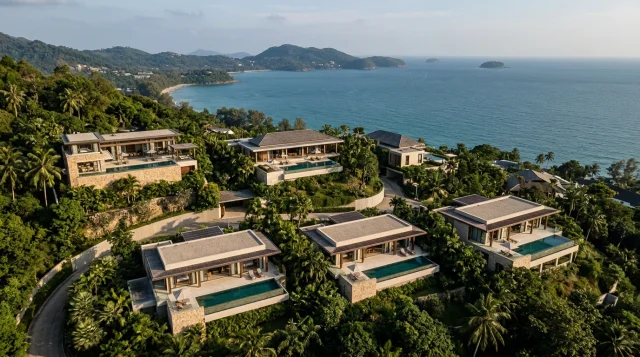
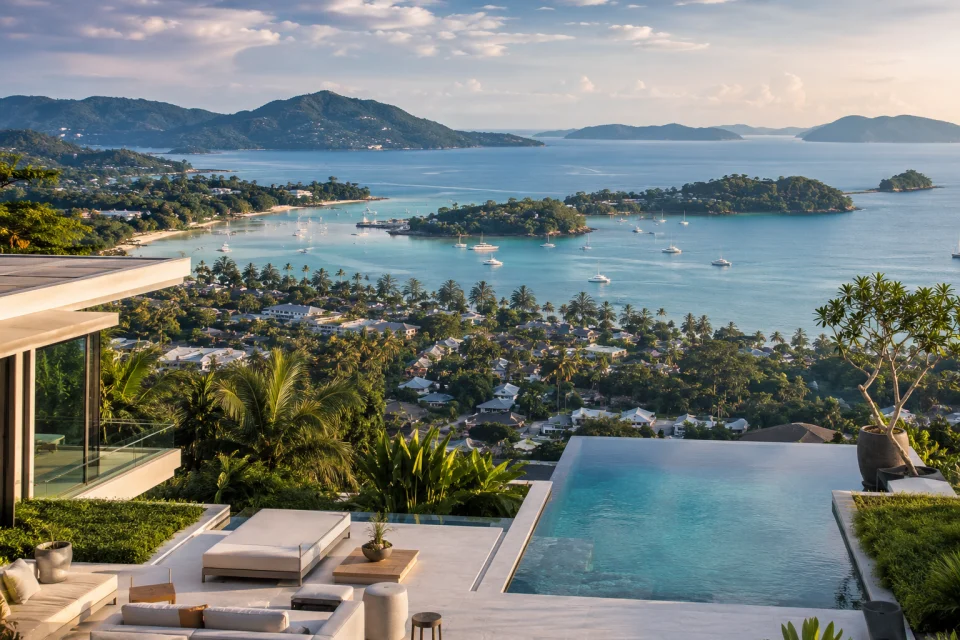
The premium ocean-view villa zone here is known as "Millionaire's Mile" and includes Kamala, Surin, and part of Bang Tao. Prices are among the highest on the island, starting at 130 000 THB/m² (around 3 700 USD) and rising from there, while individual premium properties in Kamala, Bang Tao, and Cape Yamu sell for between 100 million and over 1 billion THB.
This market segment primarily caters to buyers seeking privacy and status: gated villas with private beach access, very few neighbors, and limited new development due to the shortage of coastal land suitable for projects of this scale. For investors focused primarily on return on equity, Bang Tao or the south of the island is a more predictable choice.
Rawai and Nai Harn: where the market remains affordable and yields are higher
The south of the island offers the most affordable entry point to the market, Rawai and Nai Harn, with prices starting at 55 000 THB/m² (around 1 550 USD). Condos in Rawai start at 107 000 USD for 44 m², while villas start at 479 000 USD for 440 m². From 2023 to 2025, prices here rose from around 1 800 to 2 300 USD/m², a significant increase, though from a lower starting point than on the west coast.
Rawai is one of the island's leaders in terms of yield: a 2-bedroom villa worth around 10 million THB and rented for 70 000 THB/month generates 8.4% gross and 6.8% net annually, higher than the typical figure in Bang Tao. Demand here comes mainly from long-term expat tenants, resulting in more stable low-season occupancy than in tourist areas.
The trade-off is logistics: the journey to the airport takes 45-65 minutes via the highway, considerably longer than from the west coast. Families have access to Lighthouse Academy, a Canadian Montessori school, but the choice of international schools within walking distance is much narrower than around Bang Tao.
Chalong: balancing price, yield, and logistics
Chalong, in the center of the island, is more sheltered from tourist traffic: demand here comes mainly from families with school-age children and mid-term tenants staying for several months, while short tourist stays are the exception. Its key practical advantage is its location: every international school on the island is within a 20-minute drive of Chalong. The BISP school bus network serves Chalong as well as Bang Tao, Laguna, Rawai, Patong, and Kamala, with transport typically costing 50 000-90 000 THB per year.
In terms of yield, a 2-bedroom villa worth around 9.5 million THB and rented for 65 000 THB/month generates 8.21% gross and 6.61% net annually, comparable to Rawai. The area is also home to Oak Meadow International School, which offers a broad range of extracurricular activities, including music, art, and languages.
What regulates coastal development
Phuket's coastal zone is not open to unrestricted development: construction is entirely prohibited within the first 20 meters of the shoreline; between 20 and 50 meters from the water, building height is limited to 6 meters; between 50 and 200 meters, it is limited to 12 meters; and more lenient restrictions apply beyond that. This is one reason why new villa supply in 2025 shifted inland to Si Sunthon, Thalang, and Bang Jo, where more land is physically available for development.
Before buying a plot or villa by the sea, it is worth checking the zoning of the specific location with the local authority. The general rule provides only an approximate picture, while the exact distance from the shoreline and permitted building height determine what can actually be built or added on the plot.
Water shortages during the dry season
Phuket is a mountainous island that retains water poorly: rainwater quickly runs off, causing flooding during the rainy season and water shortages during the dry season. At the beginning of 2026, the island’s three reservoirs hold around 12 million m³, or 52% of capacity. With no rainfall, these reserves will last approximately 100 days, or roughly until the end of June.
Patong and Chalong together consume more than 60% of the island’s municipal water. These areas receive higher priority during water restrictions, but the risk of local disruptions is also more noticeable at the peak of the dry season. The authorities are considering long-term projects, including expanding the Phang Nga–Phuket water pipeline and drawing water from Ratchaprapha Dam, but as of 2026, these remain plans rather than completed infrastructure. Before buying a villa with a private pool or garden, ask the management company or the property’s legal entity how water supply is handled during the peak dry season, through a private well, a storage tank, or paid water deliveries.
Property tax on rental properties
The Land and Building Tax rate in Phuket depends not only on the property’s value but also on the ownership structure. A freehold condo valued at up to 50 million THB is taxed at the residential rate of 0.02% per year. However, a leasehold condo or villa, and in Phuket, foreigners almost always own villas through a leasehold or Thai company, is taxed at the commercial rate of 0.3% per year, regardless of whether the owner lives there or rents it out.
This difference directly affects a villa’s actual return: the net figures given above for Rawai and Chalong account for typical operating expenses, but may not include this particular item. When calculating the return on a specific property, request confirmation of the exact tax rate and usage category from the local authority, as an average market percentage is only a very rough guide here.
A foreign owner pays tax under the same rules as a Thai owner; this tax does not include a separate surcharge for non-residents. Rental income is taxed separately: rental income tax is calculated after deducting 30% in standard expenses or documented costs, and the effective rate for a private investor generally does not exceed 10–15% of gross income.
Ownership structure: the 49% quota and what may change
The ownership rules for foreigners in Phuket are the same as elsewhere in Thailand: freehold ownership is available only for condominiums and only within the 49% quota of the building’s total floor area; the remainder must be owned by Thai nationals. Foreigners cannot directly own land or a villa itself, only through a leasehold or Thai company.
Increasing the quota to 75% is not yet law. As of the beginning of 2026, the government is considering a proposal to increase the foreign ownership quota from 49% to 75% in selected tourist areas, including Phuket, Samui, Pattaya, and Chiang Mai. This is still a proposal, not an enacted law, so it is premature to base a purchase decision on it; the situation should be verified at the time of the transaction.
Phuket areas compared
| Area | Price per m² | Rental Yield | Profile |
|---|---|---|---|
| Bang Tao / Cherng Talay / Layan | 170 000–350 000 THB/m² (premium) | 7–9% gross (STR), 5–7% (LTR) | Resort infrastructure, the most liquid market |
| Kamala / Surin | From 130 000 THB/m²; villas from 100 million THB | Not the primary demand driver | Privacy, the premium end of the market |
| Rawai / Nai Harn | From 55 000 THB/m² | 8.4% gross / 6.8% net (villa example) | Affordable entry point, high yields, expat rental demand |
| Chalong | Comparable to Rawai | 8.21% gross / 6.61% net (villa example) | Families, international schools within 20 minutes, mid-term rentals |
If the comparison above has already helped you choose the right area, Private Office Property’s Phuket property listings feature properties with verified ownership structures and transparent information on each area.
For a broader overview of the Phuket market, see Phuket Luxury Property Guide: Villas, Condos, Prices and Buyer Strategy and the comparison Bangkok vs Phuket vs Pattaya: Which Luxury Property Market Is Best?. For a general overview of the Thai market, see Thailand Luxury Property: A Complete Guide for Buyers and Investors.
The legal information (ownership structure, 49% quota, status of the proposal to increase the quota, coastal zoning and height restrictions, and land and building tax rates) is based on current Thai regulations and publicly available reports on proposed changes as of early 2026; the status of the initiative and the exact tax category should be reconfirmed at the time of the transaction. Market figures (prices by area, rental yields, price growth rates, and reservoir levels) are secondary estimates from industry sources, real estate agencies, and public news reports, not audited statistics.
This material is not a substitute for due diligence on a specific property or consultation with an independent Thai lawyer before the transaction.
Need help choosing the right area in Phuket for your needs? Private Office Property listings.