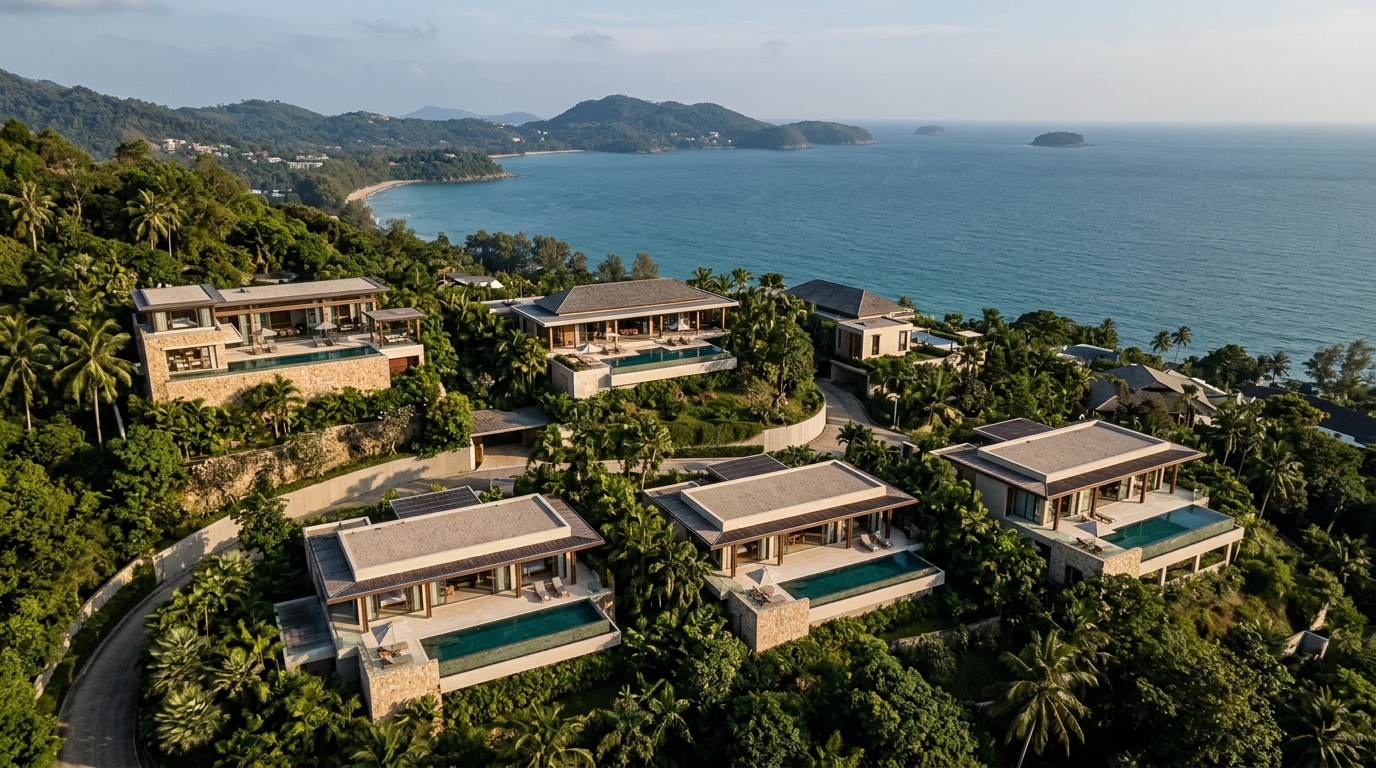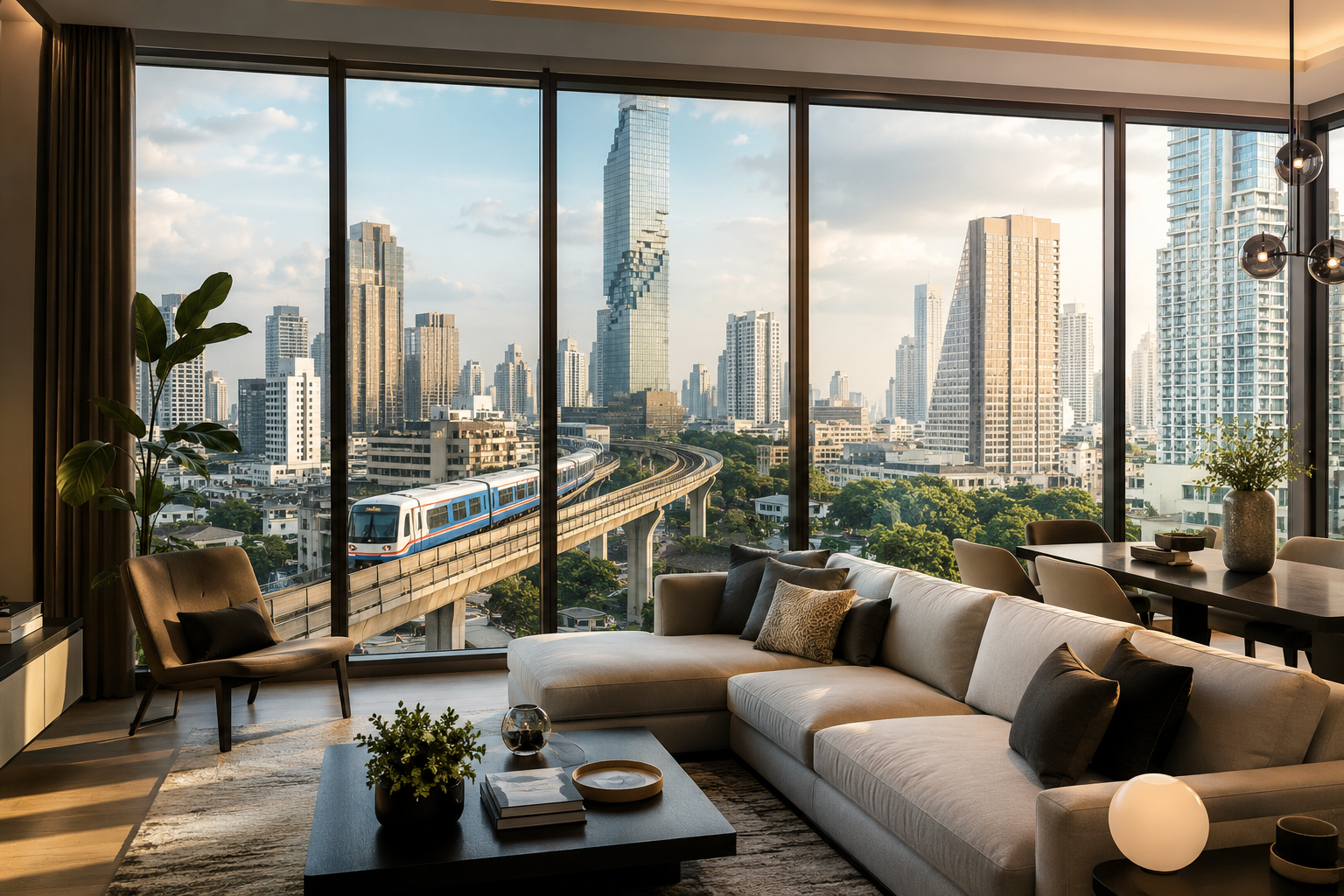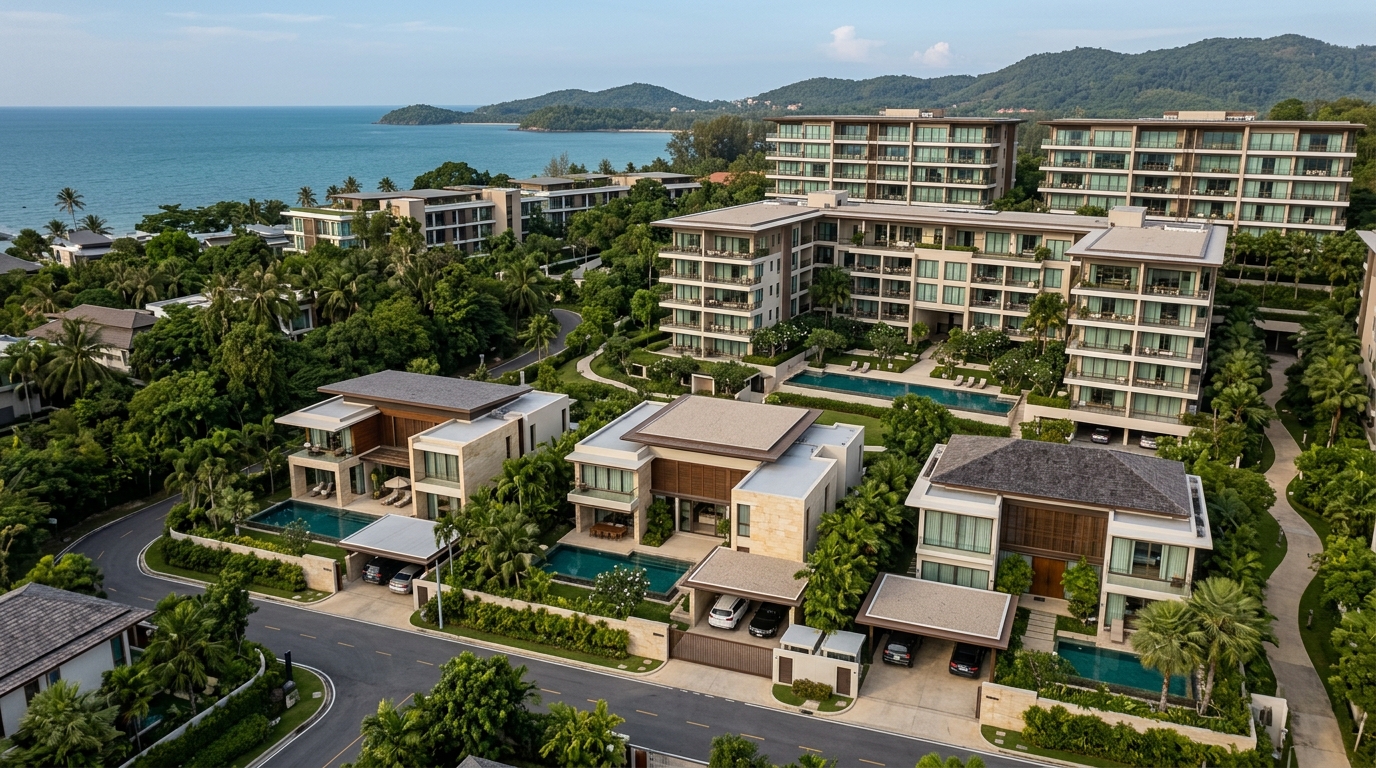
Thailand is a prime tourist location that drives continuous short- and long-term tenant demand. There are lots of luxury properties, including top-tier villas, condominiums, and long-stay residences. They might be a perfect option for preserving your money and achieving a stable return on a regular basis. How to choose real estate for luxury rentals in Thailand and get a desired rental yield? What is included in luxury villa rent in Thailand? This guide will answer most of the questions.
Condo, Serviced Residence or Villa: Which Long-Stay Format Fits?
Thailand property for rent includes luxury condos, serviced residences, managed villas, and standalone villas. Let's take a closer look at their major features, benefits, and drawbacks to see which format works best.
Luxury Condo
Privacy: Moderate, with noisy common areas and shared facilities.
Space: A typical luxury condo ranges between 50 and 150 sqm. Ultra-luxury residences and penthouses can exceed 550 sqm.
Staff and service: A high chance of having 24/7 concierge, doormen, and valet. There might be a pool or spa center, gyms, rooftop lounges, and recreation areas.
Pet friendliness depends on the building's policy and usually includes pet care stations, but tenants should be allowed by the landlord, and pets should be stated in the contract.
Access for children: Ready-made playgrounds and a higher chance to be closer to schools and kindergartens, thanks to more developed facilities and location.
Parking: Thailand apartments for rent often come with automated parking or assigned VIP slots, though some buildings charge extra for parking space rental.
Work-from-home possibilities: High-speed fiber lines are installed. Possibility to set up a home office, though tenants usually aren't allowed to drill into walls or change the lighting layout.
Maintenance responsibility: For leases covered by Thailand’s current OCPB controlled-contract rules, the lessor defines repair obligations. For other leases, responsibilities should be checked in the contract and applicable law.
Serviced Residences
Privacy: Moderate, shared amenities, though private elevators and lobbies are common.
Space: Typically from 50 to 250 sqm
Staff and service: A serviced residence in Thailand offers full hotel-style hospitality with maintenance and room service.
Pet friendliness: selective and depends on the brand.
Access for children: Family-friendly layouts are available, with kids' play areas and babysitting services.
Parking: On-site secure parking, usually with assigned underground spaces.
Work-from-home possibilities: Luxury apartments for rent in Thailand offer high-speed internet, dedicated desk spaces, executive lounges, and meeting rooms.
Maintenance responsibility: Full developer or management responsibility, including repairs, deep cleaning, and utilities handling.
Managed Villa
Privacy: Excellent; a luxury villa rental in Thailand is characterized by a stand-alone location, high perimeter walls, and private gates.
Space: Usually from 300 to 2,000 sqm.
Staff and service: On-site team that usually includes a villa manager, private chef, dedicated housekeeping, and estate security.
Pet-friendliness: Outdoor space for pets, but everything depends on the contract with the villa owner.
Access for children: Accommodation-friendly, but you may need to add pool safety fences and childproofing.
Parking: Convenient, with a private garage and driveway.
Work-from-home possibilities: Great, with high privacy, indoor and outdoor workspaces, and high-speed internet.
Maintenance responsibility: Fully managed.
Standalone Villa
Privacy: Absolute maximum with complete seclusion.
Space: Truly expansive from 500 sqm.
Staff and service: The necessity to hire all the necessary staff independently, though it is fully customizable.
Pet friendliness: Pet rules are set by individual landlords.
Access for children: Great for outdoor play, but it requires parental vigilance.
Parking: A dedicated multi-car garage and large gated driveway.
Work-from-home possibilities: Villas for rent in Thailand for a long-term period offer a quiet environment, with internet reliability depending on the local grid.
Maintenance responsibility: Handled with a landlord or a real estate agent. Usually performed by local contractors.
Format | Best for | Hidden costs | Lease/operational risk |
Luxury condo | Long-term urban residents looking for city life | CAM, Move-in/move-out deposit, cleaning, repair deductions | Strict lease terms, short-term stay risks, unresponsive landlords |
Serviced residence | High-earning individuals willing hotel convenience with apartment space | Higher utility markups, premium fees for extra services, possible VAT and service charges | Seasonal price volatility, strict cancellation penalties, and non-changeable lease extension terms |
Managed villa | Families and groups seeking resort-style luxury, high privacy, and full staffing | Mandatory estate maintenance fee, surcharges for private services | Strict noise ordinances or visitor regulations, shared estate facilities, and friction with staff management |
Standalone villa | High-net-worth people looking for absolute freedom and complete isolation | Independent utility and service bills, private security setup | Possible maintenance delays, security risks, and infrastructure vulnerability |
Where Do Thailand’s Long-Stay Luxury Rental Markets Behave Differently?
Long-term rentals in Thailand are available in several of the largest cities, each with its own peculiarities.
Bangkok's long-term rent is characterized by year-round urban and corporate demand. There is a BTS-MRT connection, with heavy traffic during peak hours. Tenants are likely to send children to the CBD urban international schools, such as NIST, St. Andrews Sathorn, Bangkok Prep Sukhumvit, etc. Corporate relocation and travel seasons can affect availability and pricing, for example, branded residences feature the highest occupancy between November and February.
The Phuket long-stay rental sphere is represented not only by a lifestyle market with luxury and ultra-luxury condos and branded residences but also by villas. Most luxury condos are located in Bang Tao, Cherngtalay, and Patong, all easily accessible via main arterial roads. Managed villas are mainly located on headlands like Kamala Millionaires' Mile and Cape Yamu, where you rely heavily on private vehicles. Standalone villas are usually beside clifftops or quiet bays, which may suffer from traffic jams during peak season. When it comes to schools, condo residents have quick access to UWC, while villa residents are likely to have a 30+ minute commute. The seasonality is traditional: high from November to April and low from May to October.
Samui vs Phangan long stay luxury rental market is defined by boutique hillside estates and beachfront properties. Therefore, those who seek a Samui villa rental should remember that short drives to amenities are required, as local roads are narrow and winding and can be challenging to navigate. Schools are located in the northern and eastern educational hubs that include International School of Samui, Greenacre, Panyadee, and Windfield, which are a 10 - 15 minute commute. Holiday-period rates can be higher, so quantify only with property-specific current rate cards and label the sample.
Pattaya condo rentals are appreciated for their coastal value, especially in Wong Amat and Pratumnak. There is a convenient connection via Sukhumvit Road & Highway 7, and less active city traffic in beachfront areas. Schools are located 20–30 minutes' drive, and you should know that peak season is characterized by a high rental demand.
What Is the Real Monthly Cost Beyond the Advertised Rent?
The real monthly cost of Thailand villas for rent for a long term time period involves not only the advertised rent.
Cost Stack | Luxury condo | Branded residence | Standalone villa |
Rent per month | Bangkok: THB 150,000 - 300,000 Pattaya: THB 60,000 - 120,000+ Phuket: THB 45,000 - 800,000 | Bangkok: THB 60,000 - 300,000 Phuket: THB 70,000 - 280,000 Pattaya: THB 22,000 - 120,000+ | Bangkok: THB 50,000 - 350,000 Phuket: THB 60,000 - 200,000 Pattaya: THB 50,000 - 175,000 |
Utilities | Electricity cost depends on meter type plus FT Sep-Dec of 0.1623 THB/kWh, service fee, and VAT of 7% Internet - 600 - 1,200 THB Water: 0-10 m³: 10.20 THB/m³, 11-20 m³: 16.00 THB/m³, 21-30 m³: 19.00 THB/m³, 31-50 m³: 21.20 THB/m³ CAM - project-specific, around THB 90 per sqm per month | The same as for condos Higher usage due to bigger square footage | The same as for condos Higher usage due to bigger square footage |
Garden & Pool maintenance | No | No | In Phuket, 6,000 - 18,000 THB a month |
Housekeeping and staff | Part-time maid in Bangkok - 3,000 - 8,000 THB a month | Included in hotel service | Live-in Maid in Bangkok 18,000–25,000 THB a month Dedicated Chef 25,000–40,000+ THB |
Parking | 1 space is included for the unit, an additional one costs 2,000 - 4,000 THB | 2 - 4 spaces included | Free |
Pet costs | Strict pet policy that may cost you a pet registration fee or a monthly pet deposit from 0 to 5,000 THB | Only pets with formal registration are allowed. You may be charged up to 5,000 THB | Free |
Move-in/move-out charges | Elevator booking deposit, move-in administration, and deep cleaning deductions 1,000 - 3,000 THB | White-glove inspection standards upon checkout 3,000 - 10,000 THB | Move-out touch-up costs, pest fumigation, and deep-cleaning fees 5,000 - 15,000 THB |
Optional services | Special hotel perks: spa, laundry, car rental, etc. | Security fees, private generator maintenance, etc. |
If you compare 6 vs 12 rent in Thailand, you may see an increase for a shorter period to cover turnover costs and potentially vacant months: a 3-bedroom private villa in Bang Tao costs 70,000 THB for a 12-month lease and an average of 83,000 THB for a 6-month one. Tenants should pay two months’ security deposit for Thailand rental plus one month in advance, which is a common quote in parts of the market rather than a universal legal requirement; for covered rental businesses, check the 2025 OCPB cap and standard-contract rules.
Which Lease Clauses Control Cost, Flexibility, and Maintenance?
When you sign a lease with a landlord in Thailand, check the following aspects.
Develop a payment schedule: payment mechanics, grace period, payment currency, and bank charges (included or not).
Ask about the utility meter basis according to government rates.
Consider a repair threshold. You should indicate that a tenant pays only for small wear items and that the maximum repair response time applies.
List what is included in the landlord's financial obligations.
Get formal written consent if you want to get a pet. Ask if a pet deposit is refundable.
Insert a clause about early termination. For OCPB-covered fixed-term leases, current rule is tied to at least half of the lease term + 30 days’ notice.
Agree renewal notice timing and any rent-review mechanism in writing.
Add a point how much prior notice is required for non-emergency access; emergencies should be treated separately.
Specify an explicit return window for deposits. It is 7-14 days under Thai Consumer Protection Board (OCPB) regulations for covered operators; for other landlords, check the contract or get legal advice.
If you rent a villa, state who pays villa maintenance in Thailand, including pool, garden maintenance, air conditioning, pumps, and other services.
Learn the juristic rules, the process of registering a tenant contract, strict limits on guest counts, pet policies, the requirement of formal booking for using common areas, modification bans, etc.
What Must Be Documented at Viewing, Signing, and Handover?
The Thailand rental handover checklist looks as follows:
Check the lease authority: If an agent signs or acts for the owner, verify written authority appropriate to that transaction.
Actual condition: run a careful inspection of the property, looking for spots, scratches, mold, paint cracks, etc. Check whether taps, heaters, and other appliances work and whether the water pressure is good.
Analyze the inventory: count the number of furniture items, rate their condition, and list available appliances, etc.
Take photos or shoot videos of visible defects: record a walkthrough tour, capture high-resolution photos of each defect, and share them with a landlord or agent.
Complete utility meter readings: take photographs and obtain receipts or juristic clearance letters.
Record the exact number of keys, access cards, and parking permits received from the landlord upon move-in.
Document emergency contacts, including the phone number of a landlord and agent, Condo Juristic Office or Estate Management office, Emergency Maintenance services, and security desk.
Review the signed handover protocol and confirm it is signed by both you and the landlord. Get a copy to attach to the rental contract.
Landlord authority is important, but you should know that some individuals are better not to deal with. If you see the following red flags, it is better to avoid transferring money since you can never get a deposit return.
Beneficiary name mismatch or refusal to show the Chanote.
Refusal to make a live inspection prior to a deposit.
Clauses in the contract allow the landlord to cut off power, water, change locks, or evict you after a 24- to 48-hour payment delay.
Refusal to issue an official receipt.
Artificial urgency, etc.
Foreigners who want to rent luxury property in Thailand should fill out special immigration forms under the Thai Immigration Act. The host, house owner, landlord or hotel manager must notify immigration within 24 hours under Section 38, while the tenant should coordinate and keep evidence where relevant.